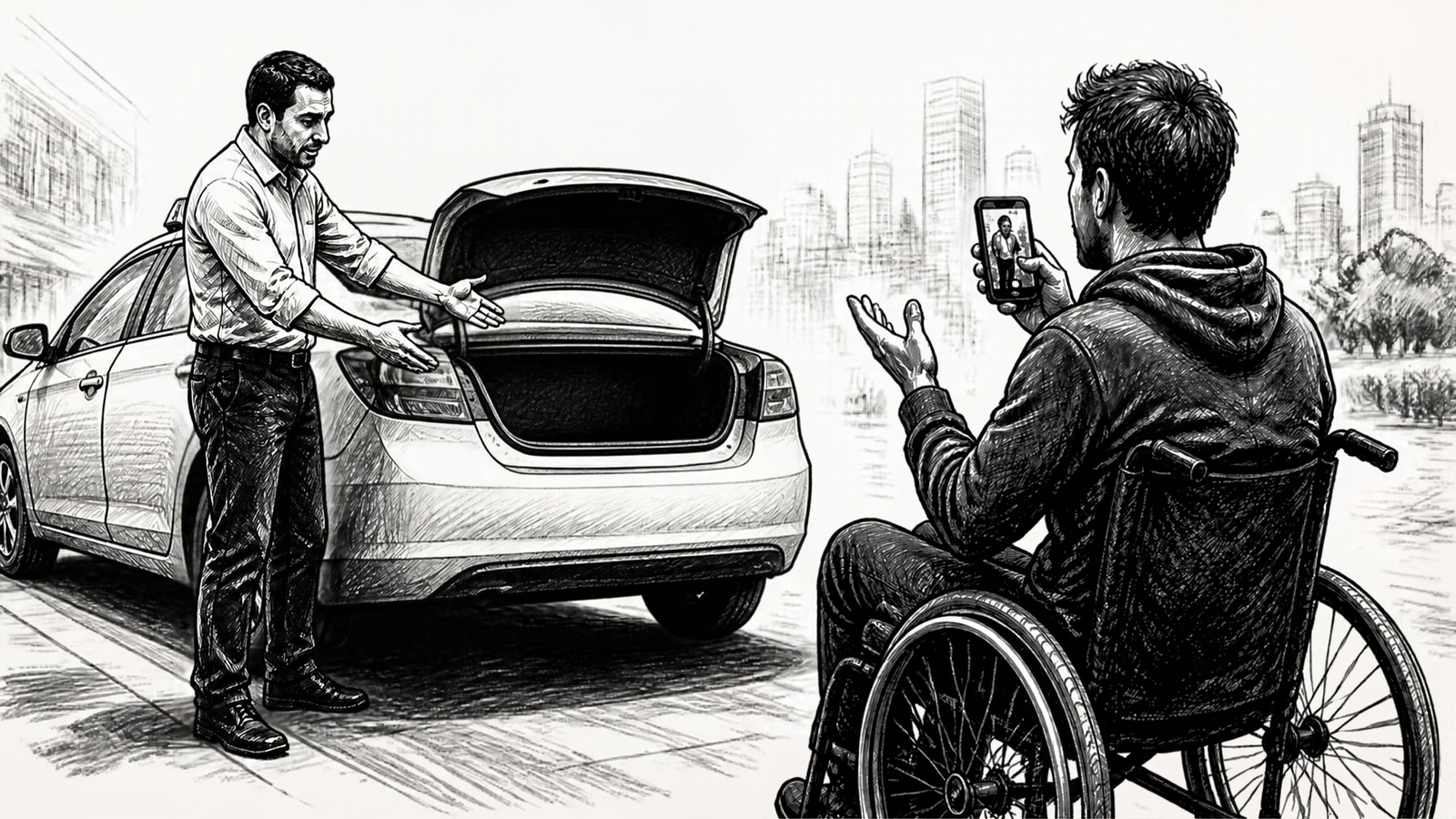
A cab driver cancels on a wheelchair user. His boot cannot take a folded chair. He says so repetitively. But, by the time he is done, a mobile camera comes out recording him.
Within a few minutes, he is an inhuman cab driver refusing to help a passenger in a wheelchair.
Mention the size of the boot and you are making excuses. Ask whether this was refusal or limitation and you are gaslighting.
The man is tried, convicted and recorded before anybody has established what actually happened.
I am going to say the uncomfortable part plainly, because I have watched such incidents on social media and it has happened to me in real life. So I have some experiential authority to talk about things.
Accessibility is a right. Non-discrimination is law. Transport we cannot board, hiring that screens us out quietly, hospitals that treat us as an expense — real, documented, worth fighting without an inch of compromise.
Very little of what passes for disability activism in India is fighting any of that.
What it does instead is take one person’s behaviour, read it as proof of collective contempt, and treat anybody who disagrees as a traitor.
The cab driver’s boot is a question for transport regulators and licensing authorities. Shouting at him puts no accessible vehicle on any road. It only finds somebody within reach to be angry at, which is easier and feels similar.
The man who grabs the back of my chair at a step without asking is clumsy, and often presumptuous. I do not know what he was thinking. I know what he did: he moved towards somebody he believed needed a hand.
Bad execution, maybe. Bad intent, I doubt.
I commented on a post once. Eleven slides, what not to say to a disabled person, stacked for maximum cringe. I said most of those questions were not offensive.
What happened to you? Is somebody with you? Let me carry your wheelchair. Do you need help?
Clumsy, yes. Tiring by the hundredth time, certainly. Contempt, no.
The reply came back: they don’t have to be offensive to be rude.
Nine words, and the entire drift sits inside them. The standard slides from discrimination to etiquette.
Discrimination has a definition you can carry into a courtroom. Rudeness has a mood, and the mood belongs to whoever is posting that day.
Ordinary people register that shift even when they cannot name it. Somebody who believes he is one sentence away from being called ableist does not become thoughtful.
He becomes cautious. He stops offering. He stops asking. He keeps a polite distance and tells himself it is respect.
The doors this movement wanted opened end up held shut from the other side — quietly, apologetically, by people who are frightened of getting it wrong.
Now the part nobody in the movement wants printed.
Look at the loudest accounts in this space and ask a simple question: what has the community actually received?
Messages go unanswered. The disabled people who get amplified are mostly the ones who are already visible. The awards, the panels, the newspaper features — those get attended.
The people being spoken for are rarely in the room.
This is not a character flaw. It is an incentive problem.
The real work is boring.
Filing an RTI about a station lift is boring. Sitting through a municipal hearing is boring. Helping one person draft a workplace complaint takes a fortnight and photographs badly. None of it trends.
Outrage trends. Awards trend. An acceptance speech cuts into a thirty-second reel beautifully.
So the work that performs gets done, and the work that changes something waits for somebody with less to lose by doing it.
Which brings us somewhere worse. The accounts loudest about dignity are usually the ones supplying the most inspiration-porn.
The term is precise rather than cruel. Inspiration-porn is content that uses a disabled life to make a non-disabled audience feel something — moved, grateful, humbled.
You have seen it. A man carried up a flight of stairs by four strangers, music over the top, captioned humanity still exists. Nobody in the comments asks why a public building has no ramp.
The staircase was the story; the video turned it into a warm evening for everybody watching. The disabled person in that frame is not the audience. He is the material.
A movement that objects to being looked at this way cannot keep manufacturing the thing it objects to. But it fills auditoriums, and policy critique does not.
I have Osteogenesis Imperfecta. I know what systemic failure looks like from inside it, and I have spent a good share of my life there.
I also know the driver who could not fit my chair was not my enemy. The man who grabbed my wheelchair meant well.
Having a disability does not make somebody an advocate. A platform built on disability is not a contribution to disabled lives.
Meanwhile nothing has moved. Transport that cannot carry us. Hiring that screens us out and never reaches a court. Healthcare that counts us as a cost. Policy barriers nobody photographs, because there is nothing in them for the feed.
All of it runs on public goodwill, and goodwill is the one resource this movement has been spending fastest — not on the system, which has learned to absorb anger, but on the ordinary people who were never the ones holding the door shut.
So it is worth asking plainly, and answering honestly: if the cause is the community, why is the community always the last to be served by it?