While reading Unseen — the story of Deepinder Goyal and Zomato — a quote stopped me mid-page:
“For the want of a nail, a kingdom was lost.”
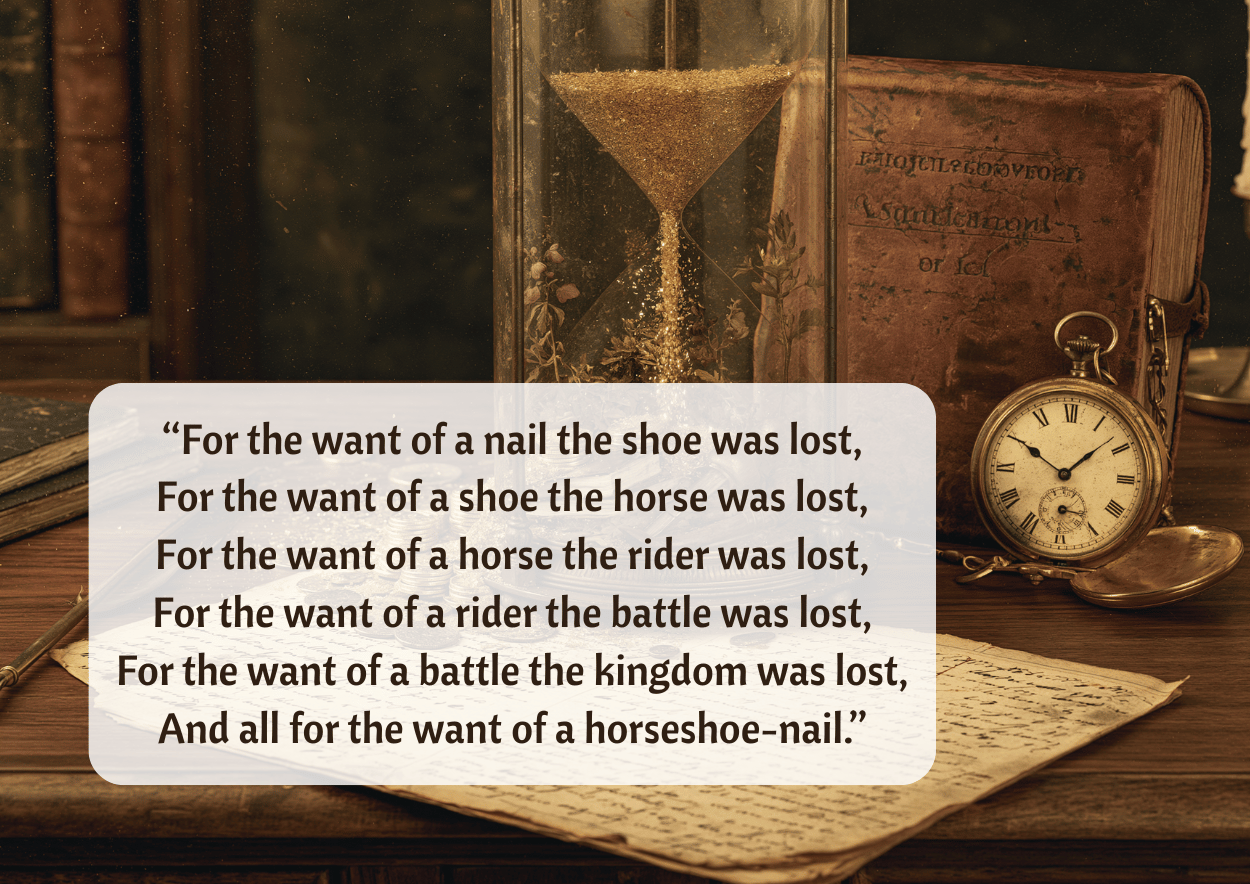
That quote made me pause, close the book and search the internet for the origin. After a bit of Google search, I landed on this book: Poor Richard’s Almanack, published by Benjamin Franklin between 1732 and 1758 as an annual almanac for ordinary working people in colonial America.
The moment you open the book, the 18th century mostly disappears. What remains is a man who understood people with an accuracy that three hundred years have done nothing to reduce.
Poor Richard’s Almanack has no argument to follow, no narrative arc, no chapter that builds on the last. It is a collection of aphorisms — compressed observations about money, character, time, work, and human nature — written to be read and returned to often. The edition that I found on Amazon strips away the almanac content and leaves what has lasted: the sayings themselves.
Franklin wrote under the pen name Richard Saunders, a fictional poor man speaking to his equals. The persona allowed him to state lessons of life in its truest and purest form. Raw and unfiltered.
These are not motivational lines designed to make you feel capable. They are observations designed to make you feel seen — which is a considerably less comfortable thing.
The sayings that carry the most weight are the ones about people. Specifically about how badly we misread the people around us — and what that costs.
On pride, Franklin is precise in a way that stings:
“The proud hate pride — in others.”
What psychology, and so aptly written. The traits we find most intolerable in other people are mostly the ones we have least made peace with in ourselves. Franklin was not writing to comfort anyone and it is a proof.
On flattery, he shared most people spend years learning the hard way:
“The same man cannot be both friend and flatterer.”
A flatterer tells you what keeps you comfortable. A friend tells you what you need to listen to. And if a person is doing the former, he is incompetent to become the latter. Franklin named this in the 1700s. It remains one of the least learned lessons in most workplaces and families today.
On enemies, he is most counterintuitive:
“The wise man draws more advantage from his enemies than the fool from his friends.”
The argument may seem like he’s favoring enemies over friends. But he is not. He is making us think if we are being wise about our human relationships. One can have enemies and friends but does one actually make anything significant out of those relationships. Sometimes, an aggressive enemy is less harmful than a friend who stays silent always.
And then there is this — perhaps the most demanding line in the book:
“Search others for their virtues, thyself for thy vices.”
That inversion — looking outward for what is good, inward for what is not — is the opposite of how most people actually operate. Which is probably why Franklin felt the need to say it at all.
The sayings on money are where Franklin’s audience of colonial tradespeople shows through most clearly — and where the distance between 1750 and 2026 collapses entirely.
“Beware of little expenses; a small leak will sink a great ship.”
“Rather go to bed supperless than run in debt for a breakfast.”
“An empty bag cannot stand upright.”
These were written for people building something from nothing, with no margin for waste and no safety net beneath them. If you are someone building your life ground-up and lifting others around you, these lines should be placed on your walls. They were relevant in the 1700s, are relevant in the 2000s and might always stay relevant.

On time, Franklin is unsparing in a way that makes procrastination feel like a personal accusation:
“Lost time is never found again.”
“Tomorrow every fault is to be amended; but that tomorrow never comes.”
“If you have time, don’t wait for time.”
That last one would either hit you hard or you’ll miss its meaning completely. It names the specific irony of delay — that the people who most often say they will do something when they have more time are the same people who, when they have it, find something else to wait for. Franklin’s sayings on time read less like wisdom and more like a mild reprimand.
Scattered through the book are observations about character that don’t fit neatly into any category but land with particular force:
“A long life may not be good enough, but a good life is long enough.”
“Being ignorant is not so much a shame, as being unwilling to learn.”
“Speak little, do much.”
That last one is the most complete professional philosophy available in the English language. Franklin managed to compress into it what most management books take three hundred pages to say imprecisely.
Reading this book in one sitting — which its length invites — produces a specific kind of mental fatigue. Not the fatigue of effort, but the fatigue of compression. Each line asks something of you. The good ones stop you. The great ones make you put the book down before you continue.
But, no book is perfect and so is this. Not every saying lands equally. Some are products of their time in ways that feel more quaint than useful — framing around servants, around gender, around social structures that belong firmly in the 18th century. As a reader in the 2020s, you may not be able to relate with them and may even question the moral compass of the author.
The more honest limitation is structural: aphorisms compress wisdom to the point where the reader must do most of the application work. It leaves us with a wide open ground to wander, to find meaning of our own and to apply tools that the author gave us as per our own understanding.
Benjamin Franklin wrote these sayings for people who had little time and no margin — people who needed practical wisdom in a form they could remember and use without a library. Three hundred years later, the delivery mechanism has changed entirely and the need has not changed at all.

The book is short. It can be read in an afternoon. But a handful of lines will stay with you for considerably longer — surfacing in decisions, in the midnight thoughts when you’re reminiscing about your life in an empty room.
For anyone who thinks seriously about how to work, how to deal with people, and what it actually costs to build a life that’s worth something — this book belongs on the short list. It will take you one sitting to read. It may take days to finish with.
Buy Poor Richard’s Almanack on Amazon: Kindle: Amazon — ₹50 (approx) | Hardcover: Amazon — ₹600 (approx)