“The most important product a founder builds isn’t the company. It’s themselves.” — Deepinder Goyal
That line appears somewhere in the middle of the book. But it might as well be the book’s first sentence, because everything Megha Vishwanath documents — the scrappy early years, the ego-driven mistakes, the near-collapses, the recoveries — is evidence of it.
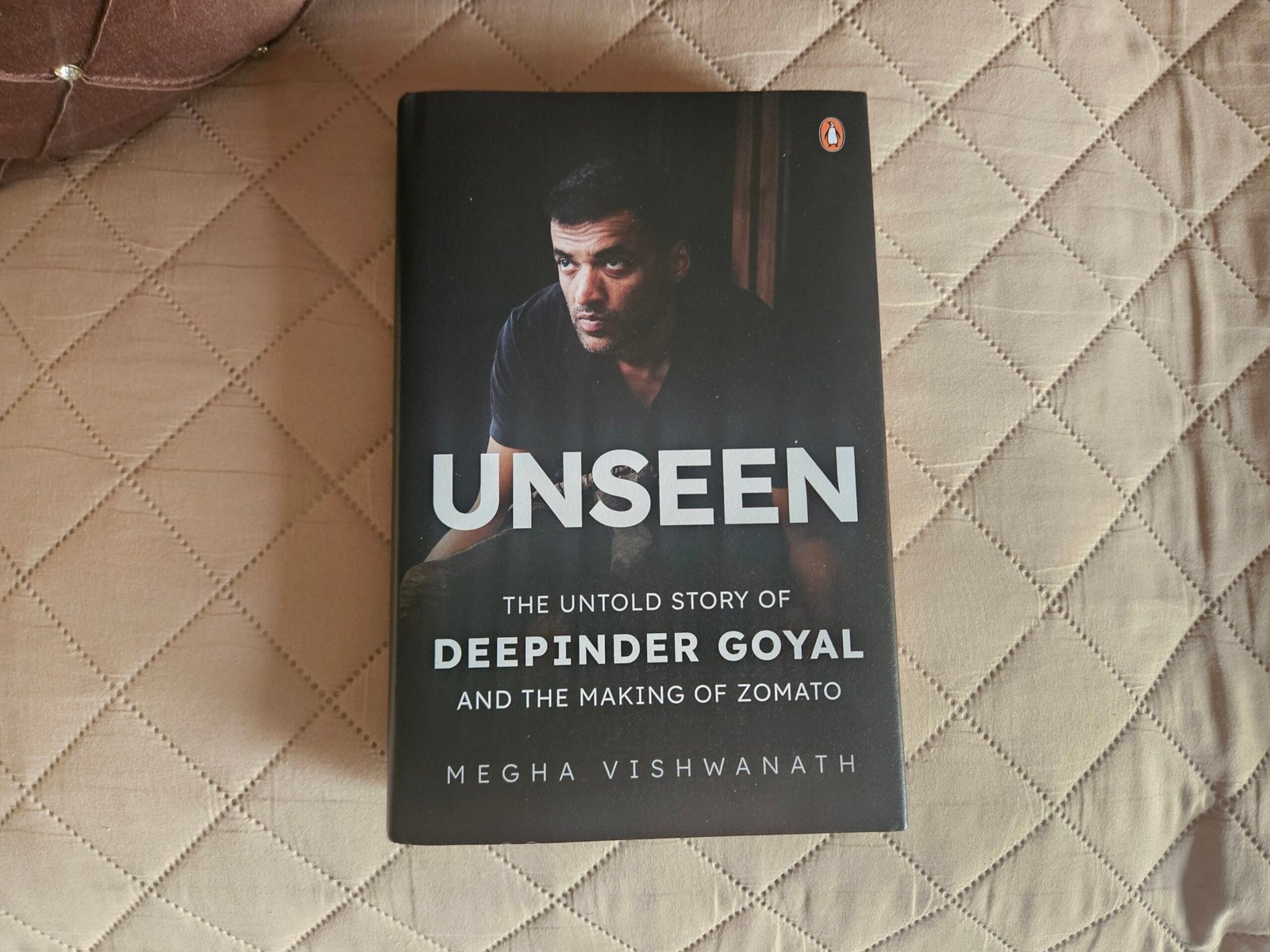
This is a book about the person who built Zomato, rebuilt it more times than one can prepare himself for, and in doing so, kept rebuilding himself. The company is the visible output. The less visible one — the founder in the process of becoming — is what Unseen is actually tracking.
You cannot separate Deepinder Goyal from Zomato. Every time you try, you lose the thread.
The company’s early shape came entirely from him — his instincts, his impatience, his refusal to wait for others to make things happen. When Foodiebay needed a website, Deepinder taught himself web development and built it. When office rent was unaffordable, Zomato ran out of a farmhouse. When he needed to hire, he didn’t look for resumes. He looked for people who would walk into a broken situation and fix it without being asked.
Interviews were conversations. Job descriptions were starting points. What mattered was agility — the willingness to do whatever needed doing, regardless of title. The people who passed that test became Zomans, and the tribe they formed became the most durable thing Zomato built.
That culture didn’t come from a values document. It came from one person’s way of being, applied consistently enough that it stopped being his and became the company’s.
One of the most distinctive elements of Unseen is its use of emails — from Deepinder, to Deepinder, and occasionally from the people around him whose thinking shaped Zomato’s direction.
They read the way emails actually read — direct, contextual and absolutely honest. In a 2017 message to his team, at one of Zomato’s lowest points, Deepinder wrote: “All the shit that we are going through is on me and I will make up for it.” It is a founder telling his people the truth about where the blame sat.
Sanjeev Bikhchandani’s emails carry a different quality — the measured thinking of someone who has seen more cycles than most. His early framing of what good investment looks like is one of the more useful things in the book:
“The secret of early stage investment is to back companies and founders who will succeed anyway. With you or without you.” — Sanjeev Bikhchandani
That quote says a lot about the Zomato-InfoEdge relationship. Bikhchandani wasn’t betting on Zomato’s model. He was betting on Deepinder’s character. The emails in this book make clear why that was the right bet to mak.
The most honest section of the book is also the most dramatic one.
Zomato’s international expansion was, by Deepinder’s own later admission, a mistake that everyone except him could see. Not market research, not a sound strategic call — ego. The company entered over a dozen markets, burned through capital it couldn’t sustain, and came close enough to collapse that everything built before it was genuinely at risk. When the retreat came, it was rapid. Country after country, operations wound down. But Deepinder and Pankaj Chhadah stood with every country manager through every closure rather than managing the process from a distance.
The recovery happened because Deepinder built the next version of himself that the situation demanded. From the ego-driven expansion to the disciplined, eventually profitable business that followed, you can trace a person forcing themselves to grow in public, at cost, without the option of doing it quietly.
That arc is more instructive than any of the cleaner success stories the book contains.
Zomato’s acquisition history runs through the book as a pattern. Runnr brought delivery infrastructure at a time when Deepinder didn’t believe food delivery was Zomato’s future — and was proved wrong by the market. UberEats India came later, a consolidation move that made competitive sense even if the optics were complicated.
But the Blinkit acquisition is the one the book treats with most depth, because it is inseparable from one of the book’s most compelling relationships.
Albinder Dhindsa and Deepinder Goyal met at IIT Delhi. They became friends, built parts of Zomato together. Then, professional tension eventually separated them.
In a couple of months, Albinder built Grofers. Deepinder helped, initially as a friend. Then Zomato invested, early, when the belief was more personal than financial. Over time, Deepinder guided Grofers toward quick commerce — a pivot that would eventually redefine what the category meant in India. Grofers became Blinkit. Blinkit became a strategic necessity for Zomato. Deepinder understood that quick commerce companies, with their more complex operations, could enter food delivery and make Zomato redundant. Acquiring Blinkit was as much defence as it was expansion.
Today, with Deepinder’s exit from Zomato, it is Albinder who leads Eternal — the group that Deepinder spent two decades building. That full arc — friendship, professional rupture, quiet investment, strategic reunion, and finally succession — runs through Unseen with great details.
A company’s culture is a self-portrait of its founder, whether the founder intends it that way or not.
Zomato’s culture holds two qualities together that most organisations end up choosing between: deep loyalty to people and zero tolerance for complacency. When the Beirut tragedy hit, Zomato responded with its people first. When COVID threatened the business, Deepinder asked employees what pay cut they were willing to take — and those who agreed received double ESOPs at discounted prices. The company’s loyalty to its people was consistent enough to become structural.
But the same company had no home for people who stopped growing. The options were clear: level up or leave. Complacency wasn’t managed. It simply had no place.
“Culture is a muscle memory.” — Deepinder Goyal
That combination existed because Deepinder held himself to both standards. He stood by his people through every crisis. He also held himself accountable, publicly, when he was the problem. The company reflected exactly the person he was in the process of building.
By the time you finish Unseen, Deepinder Goyal’s quote has earned its weight. He wasn’t offering advice when he said it. He was describing what the book documents across two hundred and forty pages — a person building himself into someone capable of what he was trying to build, again and again, at each new scale the company reached.
Megha Vishwanath found the right story inside the Zomato story. It’s not the funding rounds or the market cap or the IPO. It’s the quieter, more uncomfortable story of what it costs a person to become the founder their company needs — and what that becoming leaves behind.
If you are building something, thinking about building something, or trying to understand why building is harder than it looks from the outside, this book will give you something worth sitting with. It is not a manual. It won’t hand you a framework. What it will give you is an honest portrait of the process — which, in the end, is more useful.
Buy: Unseen The Untold Story of Deepinder Goyal | Paperback — ₹499 | Kindle — ₹314
Read: Book Review: Poor Richard’s Almanack by Benjamin Franklin