Here is something most people are reluctant to say out loud: a significant chunk of what happens in classrooms today would not survive honest competition. Not competition from a rival school. Competition from a free YouTube video.
That is the uncomfortable truth sitting at the centre of modern education. And it is long overdue for an honest conversation.
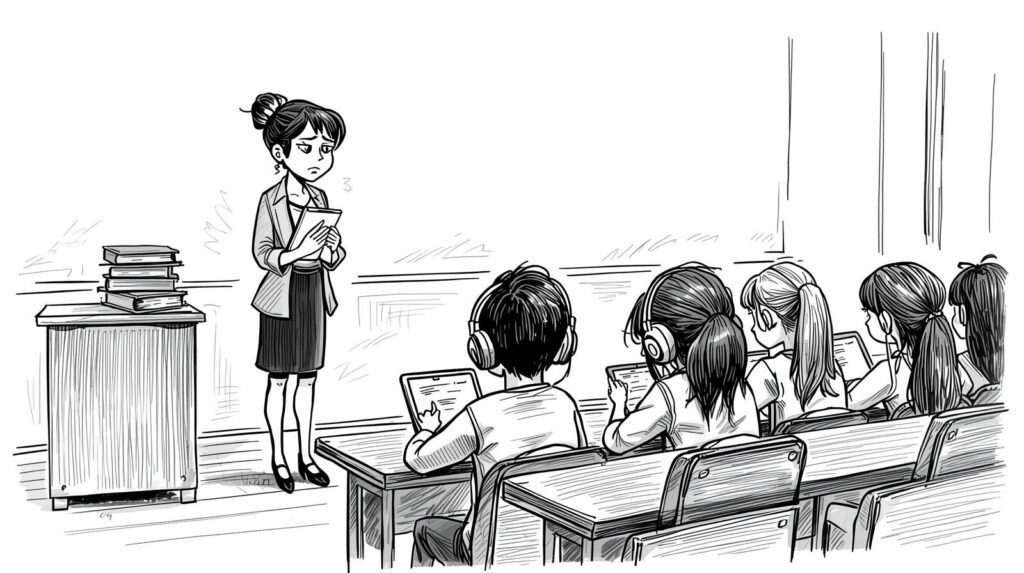
The Classroom Lost Its Monopoly
For most of human history, if you wanted to learn something, you needed a teacher in front of you. The classroom was the only gate to structured knowledge. That gate no longer exists.
Today, a curious 17-year-old in a small town can access a Harvard lecture, a Substack essay challenging mainstream economics, and a Reddit thread debating the same idea — all before breakfast. The information asymmetry that once made the teacher indispensable has collapsed. What has not collapsed is the need for genuine teaching. Those are two very different things.
The problem is that many classrooms are still operating as if the gate exists. Still reading from the same notes. Still treating the textbook as sacred. Still confusing information delivery with education.
What Lazy Teaching Actually Looks Like
Lazy teaching is not about effort. Many teachers work extremely hard. Lazy teaching is about insulation — the refusal to engage with a world that has moved on.
It looks like a lecture delivered in jargon that a three-minute Perplexity search would explain more clearly. It looks like a syllabus frozen in time while the industry it prepares students for has transformed entirely. It looks like a classroom where questions are tolerated rather than celebrated, where the goal is to complete the chapter rather than to understand the idea behind it.
The internet did not create this problem. It simply made the gap visible. When a student can find a clearer, more engaging explanation online in under a minute, the gap between what a teacher offers and what is actually available becomes impossible to ignore.
A Confession From Someone Who Learned Outside the Room
I completed my Master’s in Economics without a tutor. No coaching class. No private guidance. YouTube professors, economics blogs, and free online resources became my faculty. I was working part-time, managing real physical constraints, and learning on my own schedule.
I say this not to celebrate myself, but to make a point: if self-directed digital learning can carry someone through a postgraduate degree under those conditions, the traditional classroom has a much harder case to make for itself than it realises.
That experience changed how I think about education permanently. It is not about access to information anymore. It never really was. It is about what you do with it.
The Teachers Who Are Irreplaceable
This is where I want to be precise, because a sweeping critique of all teachers would be both unfair and wrong.
There are teachers who do something no algorithm can replicate. They read the room. They notice the student who understood the concept but is too hesitant to say so. They connect Newton’s laws to the football match from the weekend. They challenge you on what you believe and make you defend it with evidence. They teach you how to think, not just what to think.
That kind of teaching — empathy, mentorship, the shaping of judgment — is genuinely irreplaceable. No AI tutor, however adaptive, has figured out how to care about a student’s trajectory the way a committed teacher can. Not yet, possibly not ever.
The question is not whether great teachers matter. They matter enormously. The question is whether the average classroom is even trying to be great, or whether it has settled for merely showing up.
Evolution Is Not Optional
The teachers who will remain relevant — truly relevant, not just employed — are the ones who understand that their job is no longer to be the smartest person in the room. It is to be the most useful one.
That means using every available tool — including AI, including the internet — not as a threat but as an extension. Draft the lesson outline with ChatGPT if it saves time. Use that time to spark a real debate. Connect the theory to something your students actually care about. Build judgment, not recall.
Students have already voted with their attention. The ones who are genuinely curious have found other classrooms — on screens, in comment sections, in podcasts, in long-form essays written by practitioners rather than textbook committees. They did not leave because they stopped valuing education. They left because education stopped valuing their curiosity.
The internet did not kill good teaching. It never could. What it did was make mediocre teaching impossible to hide.